Army Rugby Union – A History
Origins of Rugby and its Army connection (1823)
There is a connection between the origins of rugby and the Army by virtue of the fact that William Webb Ellis (1806-1872), who is credited with inventing the game at Rugby School in 1823 when he showed a “fine disregard for the rules of football [soccer] … took the ball in his arms and ran with it, thus originating the distinctive feature of the Rugby game”, was the son of an Army officer, James Ellis.
The game was gradually institutionalised through it being played at other British Public schools and universities. it was during the second quarter of the nineteenth century that rugby acquired its distinctive features such as an oval ball, H-shaped goals, scoring above the cross bar, and points for ‘tries’ as well as ‘goals’.
Initially, like other sports within the Army, rugby was as officers’ game, because until the Second World War (1939-45) the Army generally recruited its officer corps from public schools and those recruits brought the game with them. It was only after they had taught their soldiers how to play that the game became truly inclusive.
Birth of Army Rugby (1855)
In March 1859 the 2nd and 3rd Battalions of the Grenadier Regiment of Foot Guards played twenty-five-a-side game at Lords Cricket Ground, London; the game ended in a draw.
Early developments of Army Rugby (1862-79)
Early game rules (1862-67)
The following year the School of Musketry, Fleetwood, Lancashire played a thirteen a-side rugby team against Rossall School (a local public school founded in 1844) in a match that was played under the Harrow rules.
During the 1866/7 season the 8th Depot Battalion at Colchester, Essex was said to have a good side which played under a combination of Eton and Rugby school rules.
Early matches (1864-79)
Likewise the 94th Regiment and 93rd (Sutherland Highlanders) Regiment, stationed in Ireland, arranged matches against such clubs as Landsdowne, Dublin Wanderers and Dublin University. The 21st Lancaster Rifle Volunteers played a match against Oldham Club during the 1878/79 season.
Within the Army matches between Royal Military Academy, Woolwich and the Royal Military College, Sandhurst began in 1876 and continued until the Royal Military Academy, Woolwich was closed in 1939.
Army Players and International Representation (1871 onwards)
Standard codes of playing were developed in the 1870′s during which time governing unions were formed: The English Rugby Football Union (RFU) in 1871, the Scotland Rugby Union in 1873, Irish Rugby Football Union in 1874 (the two Irish Unions were merged in 1879) and the Welsh Rugby Union in 1880. These unions organised the game and arranged international matches in which many officers, and later soldiers, who played for first-class local teams, were selected to represent their respective nations.
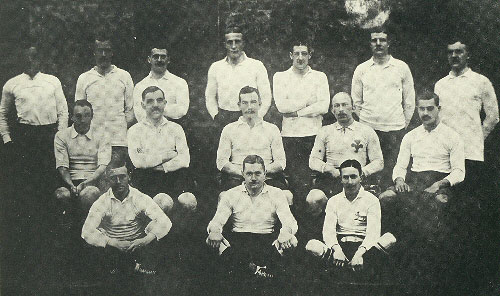
England – Two Royal Engineers (Sappers); Lieutenant CW Sherrard RE (2 England caps) and Lieutenant CA Crompton RE (1 England cap), both members of Blackheath RFC, became the first soldiers to gain the distinction of playing for their country (England) in the first ever international game. The Scotland v England match played at Raeburn Place in Edinburgh, 27 March 1871, in front of a crowd of 4,000 (Scotland won by one goal and one try to one goal, the teams were 20-a-side and Halves were 50 minutes each).
Those chosen to captain the England team were:
| Year | Name | No of Caps | Regiment |
|---|---|---|---|
| 1928 | AL Novis | 7 | Leicestershire Regiment |
| 1930 | DA Kendrew | 10 | Leicestershire Regiment |
| 1947 | NM Hall | 17 | Royal Signals |
Scotland - The following year (1872) they were followed by Lieutenant FT Maxwell RE and Lieutenant HW Renny Tailyour RE, also Sappers, who were capped for Scotland. (Renny Tailyour also played cricket and soccer and was a member of the Sapper Football team that won the FA Cup in 1875.
In 1912 Lieutenant CM Usher, Gordon Highlanders was the first soldier to Captain his national team (Scotland). In his international career he gained 16 caps for Scotland. Others were:
| Year | Name | No of Caps | Regiment |
|---|---|---|---|
| 1912 | CM Usher | 16 | Gordon Highlanders |
| 1948 | A Cameron | 17 | Royal Artillery |
| 1957 | KJF Scotland | 27 | Royal Signals |
| 1961 | MJ Campbell – Lamerton | 23 | Duke of Wellington’s Regiment |
| 1963 | JP Fisher | 17 | Royal Army Dental Corps |
Wales – In 1881 Lieutenant RD Garnons-Williams, Royal Fusiliers gained a cap for Wales. Sadly at the age of fifty-nine Garnon-Williams was killed in action, whilst commanding his battalion, at Loos on 27 September 1915.
In 1947 Captain J Matthews, Royal Army Medical Corps was chosen to captain the Wales team. He was awarded 17 Welsh caps.
Ireland – Lieutenant AP Cronyn, Royal West Kent Regiment was the first Army officer to be selected to play for Ireland in 1875 and was awarded 3 Irish caps. He was followed in 1877 by HW Murray, Indian Medical services.
Full details of Army personnel who have been awarded caps can be seen on International Caps page.
Army v Navy Matches and Inter-Service competitions (1878 onwards)

The Championship was suspended during the First (1914-1918) and Second World War (1939-45) but resumed in 1920 and 1946 respectively. An account of the match can be found on the Army Navy Match (1878-1914) page.
The Royal Air Force (RAF), formed in 1918, became competition participants in 1920. In the early years of the Championship the Royal Navy dominated the game, but since the Second World Wars the fortunes of Army has been in the ascendancy (see the Inter-Services Championship statistics).
Separate Inter-Service competitions were created for women and veteran (over 35 years) service teams in 2003. Since the inauguration of the women’s competition the Army Women have dominated the championship.
The Army and the Global spread of Rugby (1870′s onwards)
The Army did much to spread an enthusiasm for rugby worldwide as indeed it did for our other great national games; cricket and football. Interest in the game was generated by the regiments stationed throughout the British Empire who had regimental rugby teams that played locally.
Australia - The Australia RU claim that there “are reports of early games of rugby between the army and the crews of visiting ships being played at Barrack Square in the city [Sydney] in the 1820s” – but given the early date it is unlikely that they were playing rugby as we understand it.
Canada – The first game of rugby recorded in Canada took place in Montreal among artillery men in 1864. On the West coast the first game in British Columbia was played on Vancouver Island in 1876, between members of the Royal Navy and the Army. In 1919, a Canadian Services Team played overseas against representatives from England, New Zealand, South Africa and Australia.
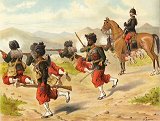
The 29th Bombay Native Infantry (Duke of Connaught’s Own Belooch Regt) Field Firing (Marching Order) by Richard Simkin – Part of Major General Biddulph’s Thul Chotiali Force in 1878.
The Army and the Calcutta Cup (1878-9)
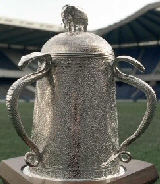
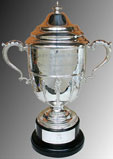
But after finding 270 silver Indian rupees in the kitty its committee decided that they would make a cup with them – thus the Calcutta cup was born with its distinctive Indian favour that consisted of patterned bowl, three sculptured cobras as handles and an elephant adoring the lid.
The committee was keen to perpetuated the name of the club and decided in 1879 to present their Calcutta cup, to the English Rugby Football Union on the proviso that it should be competed for annually by representative rugby teams from England and Scotland. The Cup was first competed for on 10th March 1879 – the match, at Raeburn Place, Edinburgh ended in a 3 all draw.
The following year on 28 February 1880 England become the first winners of the Calcutta Cup when they beat Scotland at Manchester by 2 goals & 3 tries to 1 goal.
Formation of Army Rugby Union (1906-8)
On 16 June 1908 the Army Rugby Union Committee convened for the first time; it concluded that:
- Army teams should wear red shirts and stockings and white shorts. They later confirmed that the strip should be:
- Red jersey with a white collar and white badge formed of the letters ARU with ‘Royal Cypher’ above, also in white.
- Stockings – red with white tops (5 inches).
- White shorts.
- Fixtures against Oxford and Cambridge Universities should be a high priority; these fixtures remain a highlight of the Army Senior XV’s season each year.
- An executive committee should be elected; those elected in 1908 included representatives from the Army Ordnance Corps, the Royal Army Medical Corps and the Leicestershire Regiment.
Army Cup – The Beginnings (1907-8)
The trophy was presented by General Sir John French. The 1908 Army Cup final, played at Aldershot, between 1st Leicestershire Regiment and 1st Welch Regiment was initially postponed due to snow. When it was eventually played the game was won by the Leicestershire Regiment 5 points to 4 – a goal to a drop goal.
It was a very hard game in which the Leicestershire Regiment managed to maintain their record of never having their opponents cross their line in an Army match that year.
See Army Cup (now the Premiership Cup) statistics.
Army Rugby and the First World War (1914-18)
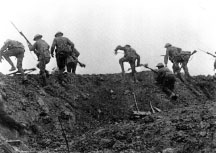
During the sixty-year period leading up to the First World War sport became one of the pillars of military training under a philosophy of “training for sport was training for war” . The playing of sport, which included rugby, coupled with ‘physical PT’ helped to prepare the British Army for the rigours of war and was a guiding principle in the physical training of the civilian volunteers who made up Kitchener’s Army that was to replace the ‘Old Contemptible’s’ of the original British Expeditionary Force (BEF).
In May 1914, on the conclusion of the 1913-14 season, the ARU decided that there would be no Army v Navy matches and that the Army Cup competition would be suspended for the duration, both competitions resumed in 1920. On the outbreak of war the Royal Military Academy, Woolwich and Royal Military College, Sandhurst also suspended their matches but resumed them in 1916.
In 1915 a newly formed battalion of Northumberland Fusiliers recorded in their journal that: “The rugger and soccer teams are now quite an institution and every Saturday afternoon sees an inter-Company match or a match with a local battalion.” (quote from St Georges’s Gazette Vol 33, the journal of the Northumberland Fusiliers). The men took this sporting spirit with them into battle.
After the war a memorial match to commemorate the life and achievements of “Mobbsy” was instigated in 1921 and is now the longest standing fixture of the Barbarians RFC.
On 17 March 1918, just a few days before the German Spring Offensive (Operation Michael, which began on 21 March), the 20th (Light) Division, located in the St Quentin area as part of the Fifth Army, organised a knock-out contest featuring rugby and other sports. Similar contests were frequently held throughout the war at the training camps in Britain, France, and other theatres of operations. In some cases where the games were played under Northern Union rules there was some question over the playing status of ARU members.
The ARU between the wars (1920-39)
In the aftermath of the war Maj Gen CE Heath CVO CB was elected President and Major JR Rainsford-Hannay DSO, Secretary and under their leadership the ARU slowly began to pick up the pieces.
Inter-Services Championship (1920)
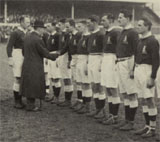
In 1920 the newly formed Royal Air Force (RAF) began to enter a team into the Inter Services competition and were beaten by the Army (21-9) in their first match against “the Reds”.
The era was seen as ‘golden’ with the Army side dominating the Inter Services competition frequently beating both the Navy and RAF sides to win the overall competition.
For more see the Inter-Services Championship statistics
British and French Army matches (1920-31)
In the same year a match between the two allies’ armies British and French was organised and repeated until 1931.
| Year | Winners | Venue |
|---|---|---|
|
1920
|
French Army (15-6) | Paris |
|
1922
|
British Army (13-6) | Paris |
|
1923
|
French Army (15-6) | Twickenham |
|
1924
|
British Army (21-17) | Paris |
|
1925
|
Drawn (9-9) | Twickenham |
|
1926
|
British Army (19-13) | Paris |
|
1927
|
British Army (12-6) | Twickenham |
|
1928
|
French Army (29-10) | Paris |
|
1929
|
British Army (21-8) | Twickenham |
|
1930
|
British Army (5-0) | Paris |
|
1931
|
British Army (21-12) | Twickenham |
Army Cup (1920-39)
The Welsh regiments dominated the Army Cup competition throughout the period 1920-1939:
| Cup Winners | Year |
|---|---|
| 2nd Bn Welch Regiment | 1920, 1921, 1922, 1924 |
| 1st South Wales Borderers | 1925, 1926, 1927, 1928 |
| 1st Bn Welsh Guards | 1934 |
| 1st Bn Welch Regiment | 1935, 1937, 1939 |
For more see Army Cup (now the Premiership Cup) Statistics.
International representation (1930′s)
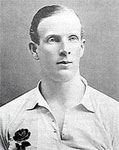
In 1929 AL Novis, Leicestershire Regiment captained the England XV as did DA Kendrew, Leicestershire Regiment the following year. During the 1930s Army players were selected to play for their national teams as well as the British Lions.
Refereeing and the founding of the Army Rugby Union Referees Society (1921-39)
The question of refereeing both representative and unit matches was raised at an ARU meeting in 1921, but it was not until 1931 that the first list of Army referees was published. Top of that list was Lieutenant Colonel HC (Tiny) Harrison, who took up refereeing after playing for England (1909-14). He refereed the 1922 France v Scotland match.
Captain WDC Greenacre was the first Army referee to represent the ARU in the London Society of Referees. He was later selected as the first Chairman of the Army Rugby Union Referees Society (ARURS) in 1939.
For more see ARURS history
Army Rugby and the Second World War (1939-45)
During the ‘Phoney War’ period (Sep 1939 – May 1940) a British Army team played a French Army team in Paris on 24 February 1940, the match was won by the British (36-3). Just fourteen weeks later the Germany Army had over run Northern France and the remains of the British and French Armies were being evacuated off the beaches of Dunkirk. Paris fell to the Germans on 14 June 1940.
Games were played at home and overseas throughout the war and were enjoyed by both Union and League players from all three Services. Matches took place as far a field as Singapore, Kuala Lumpar, Cario, India and Burma. There is also a record of rugby being played in prisoner-of-war camps in Europe.
Services Rugby – a national morale booster (1942-45)
At home rugby played its part in maintaining national morale for in 1942 a number of Service International matches, with teams drawn from Servicemen, were played at a variety of venues across the British Isles. The matches were played between teams representing England, Scotland and Wales and aroused immense interest among the general public so were continued until the end of the war.
Rugby League versus Rugby Union (1943)
A unique match took place in 1943 between a Northern Command Rugby League XV and a Northern Command Rugby Union XV. It was played at Headingly, Leeds under RU rules and was won by the League XV (18-11).
Just after the end of the war in the Far East two units of the Parachute Regiment of the 6th Parachute Brigade played each other in Java, the game was watched by a large number of Japanese prisoners-of-war.
The ARU during the Cold War Period (1945-90)
The first matches to be played after the Second World War in 1945 were between the Army team and a team fielded by the newly formed British Army of the Rhine (BAOR), the Army XV won both games.
New Zealand Army Tour (1945-46)
The 2nd New Zealand Expeditionary Force (The Kiwis) played a total of 33 games including matches against the British Army, France and Scotland. The British Army lost the match (25-5).
(Postnote – the Kiwis reprised their historic tour in 2005: on that occasion they lost to the British Army 25-15, but their Women’s team beat the British Army women’s team 24-8).
National Service (1949-62)
The period of National Service and operational moves to Malaya (1948-57), Korea (1950-53), Kenya (1952-56), Cyprus (1955-59) and Suez (1956) meant that more men played for the Army XV during this period than in any previous or subsequent time, so the Army were still a power in British rugby reflected by the fact that 30 Army players represented their country and that national team captains were often serving soldiers:
| Year | Player | Country | Regt/Corps |
|---|---|---|---|
| 1947 | J Mathews | Wales | Royal Army Medical Corps |
| N M Hall | England | Royal Signals | |
| 1948 | A Cameron | Scotland | Royal Artillery |
| 1957 | K J F Scotland | Scotland | Royal Signals |
| 1961 | M J Campbell-Lamerton | Scotland | Duke of Wellington’s Regiment |
| 1963 | J P Fisher | Scotland | Royal Army Dental Corps |
Army Cup (1960-89)
In the 1970s the Army Cup was dominated by the Welsh regiments. The 1st Bn Welsh Guards won the competition in 1970, 1971 and 1973. The first two matches were all Welsh finals with the 1st Bn Royal Regt Wales the losers. However, they did win the Army Cup in 1974, 1976 and 1977. The other winners in the decade were the Yorkshiremen of the 1st Bn Duke of Wellington’s Regt in 1972, 1975, 1978 and 1979.
The 1980s opened with a win for 3rd BAPD, Royal Army Ordnance Corps against 1st Bn Royal Regt Wales. This break for the tradition winners led to wins by 21 Engineer Regt, Royal Engineers (1983) and 7 Signal Regt, Royal Signals (1984, 1989) but there also emerged from the decade a team which would dominate the competition in the coming decade, the team was 7th Regt Royal Horse Artillery who showed early promise when they won the Army cup in 1985, 1987 and 1988.
For more see Army Cup (now the Premiership Cup) statistics.
The Inter Services Competition (1960-89)
For more see the Inter-Services Championship statistics
The ‘New Order’ Era (1990-2006)
The fall of the Iron Curtain in 1989 heralded the end of the Cold War and the start of a new era, which triggered a review of the armed services under the title of Options for Change. The review brought about changes in the size and deployment commitments of the Army, which had an impact on the Army Rugby Union.
The Inter Services Competition (1960-89)
During the 1990’s the Army’s performance in the Inter-Service Competition was varied, they won the competition in 1990, 1997, 1998 and 1999. There was a triple-tie in 1992 and 1996.
The Army XV’s performance was greatly enhance by the inclusion of Fijian soldiers serving with the British Army.
Under the coach, Lt Col A Hickling, Royal Signals the Army dominated the Inter-Service Competition through the first half of the 2000′s wining the competition for a record fifth successive time in 2005.
For more see the Inter-Services Championship statistics
Women’s Rugby (1996)
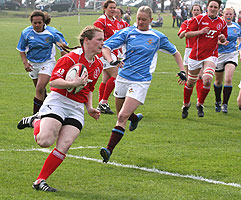
A Women’s Inter-Service Competition was introduced In 2003. The inaugural competition was won by the Army who, under the captaincy of Major S Butler, beat both the Royal Navy (35-5) and the RAF. Since its inception the Army has dominated the competition.
In 2005 the women made their first international tour to Canada it was followed with a tour to New Zealand in 2008.
For more see Women’s Rugby History
Army Cup (1990′s)
The Army Cup was dominated by 7 Regt Royal Horse Artillery during the 1990’s. In ten years they won the Cup on 8 occasions (1990, 1991, 1992, 1993, 1995, 1996, 1998 and 1999). Their only serious rivals were 7 Signals Regiment who beat them in the final of 1994. They did not manage to get into the finals in 1997, when the final match was between 2 Signals Regiment and 1 Royal Welch Fusiliers. The 2 Signals Regiment won.
A major reorganisation of the community rugby competitions took place during the season of 2006-07.
- Inter Corps Championship (formerly Corps Merit Table).
- Premiership Cup Competition (formerly the Army Cup).
- Community Cup and Shield Competition.
- Army Seven-A-Side Tournament.
Army Sevens (2000)
The Army has a long history of playing Sevens at club level and annually holds a major tournament culminating in a finals day at Aldershot. But it was not until 2000 that the army formed a representative team, which become the Army Sevens. Since its formation it has developed into a formidable team and has become a significant force in the game. They have won some of the games’s major competitions: Middlesex Sevens, Dubai and Singapore.

The Centenary Season (2006-07)
Part of the Centenary celebrations included a Centenary Dinner in London and a ‘Festival of Rugby’ held at Aldershot.
In June 2007 the Senior XV Squad embarked on its Centenary Tour of Australia and New Zealand, where they defeated teams fielded by the Australian Army (36-0) and the New Zealand Army (11-6).
The Next 100 Years
101st Season (2007-08)
On 10 May 08 a British Army (Germany) XV stunned a touring Australian Army XV by beating them 15 points to 13 at Sennelager.
The 2nd Royal Welsh beat 23 Pioneer Regiment RLC to win the Premiership Cup (ex-Army Cup). The Community Cup was won by 17 Port & Maritime Regiment RLC and the Shield by 3 Scots. The men of Royal Engineers won the Corps competition.
The Corps competition was extended to include the women and was won by the REME, who beat the women of the Army Medical Services.
102nd Season (2008-09)
The 2008-09 season was another very successful season for the ARU. The Army representative teams secured a clean sweep in the Inter-Services Championships.
In the Corps Competition the Sappers secured a ‘triple crown’ by beating the REME (28-8). The Community Cup competition was won by SEME, who beat BA (G) based ARRC SP (18-6). The 1 Scots won a ‘double’ by beating Welsh Guards (29-20) to win the Premiership Cup in March 09 and followed that success by beating 17 P&M Regt RLC (42-12) to win the Army Sevens Tournament on 20 May 09. The BA (G) Sevens Tournament was won by the Scots DG (B Team), who beat the Scots DG (A Team) (64-10) and the Women’s Sevens Tournament was won by the REME (W), who beat the RLC (W) (39-12).
103rd Season (2009-10)
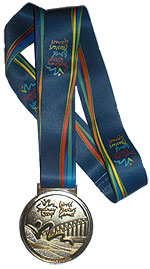
The season opened with a BA (G) rugby tour to Italy (27 Aug – 4 Sep 09), which sadly ended in defeats to Venice RFC (an Italian super 10′s side) and Roma Rugby (33-17). The Army Veterans entered the Sydney World Masters Tournament (10-18 Oct 2009) to emerge as the rugby Gold Medallists after beating the hot favourites, the White Hart Marauders 7-5 in the final. In honour of their success the team was re designated the ‘Army Masters XV’.
The Senior Squad held its usual pre-Inter Services training in South Africa, but due to volcanic ash from eruptions in Iceland that grounded aircraft in Europe, were unable to return in time play their fixture against the RAF. The match was subsequently cancelled. Their performance in the Army Navy Match at Twickenham was disappointing resulting in a 22-24 defeat leaving the Navy as Champions for the first time since 2001.
The Women’s XV maintained their undefeated record in the Inter-Services by beating the RAF (35-12) and Navy (25-11). Their founder and chairwoman, Lt Col EE Cunningham stepped down from the chair at the beginning of the season.
The Army Master’s XV unfortunately lost their RAF Inter Services match 10-6, but defeated the Navy 28-19. The RAF, who beat the Navy, were declared the Champions.
The Army U23′s repeated their previous season’s performance beat both the RAF (22-3) and Navy (30-5).
Pte Apo Satala (1 SCOTS) was capped for Fiji and represented his country in matches against Scotland and Ireland. LCpl J Leonard (RE) was selected to play for England and was awarded ‘Combined Services Female Sports Personality of the Year’.
In the Corps Competition held at the beginning of the season the Sappers won the 15′s beating the RLC, the RAC won the 10′s beating Int Corps and the RLC overcame the REME in the Women’s competition. The Sappers continued their success when they were crowned the Corps (Merit Table) Champions for a fourth time. They beat the RLC 35-25. In the Women’s Corps Championship the RLC v REME final was reprised with the RLC being victorious again.


25 Engr Regt beat 29 Cdo Regt RA to win the Community Cup whilst the Community Shield went to 5 SCOTS who beat 16 Regt RA.
A cracking ‘all Welsh’ Premiership Cup final between 2 Royal Welsh and 1 Welsh Guards was played at Aldershot. The Guards who had lost the final to the 1 SCOTS the previous season were again to be the cup runners up losing to the 2 Royal Welsh 31-26.
The final competition of the season, the Army Sevens Tournament, ended in controversy when the winners of the Men’s Cup, 17 P&M Regt RLC, withdrew from the Tournament leaving the vanquished 1 SCOTS the winners. The Men’s Plate was won by 23 Pnr Regt RLC who beat 3 SCOTS (22-10) and the Ladies was won by the RLC Women who beat AMS (22-10).
History compiled by: Simon Fenwick
See ARU entry on www.wikipedia.org
Read a history of Rugby Union at www.rugbyfootballhistory.com
Source
McLaren Lt Col J: The History of Army Rugby (Aldershot, The Army RFU, 1986)